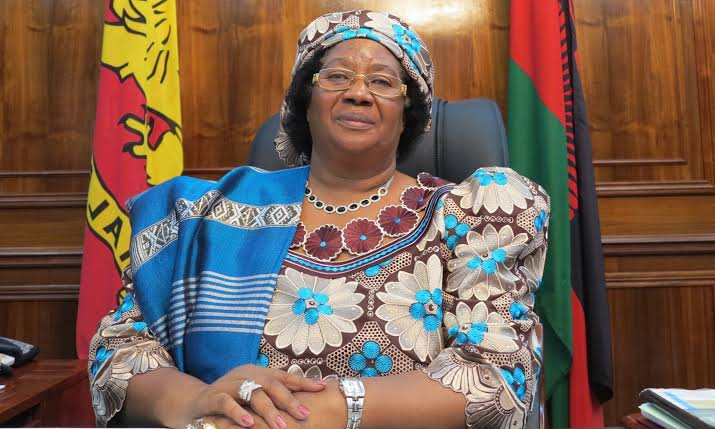
To Malawi’s first woman president Joyce Banda, leadership is a love affair. Recently, she was in South Africa to receive the Broad Pool of Ideas (BPI) Foundation Lifetime Achievement Award in recognition of her contributions to democracy. During the trip, she caught up with Newzroom Africa journalist IMAN RAPPETTI to reflect on her leadership journey and women leadership on the continent. Excerpts:
Q: How does that feel, particularly the award that you received from the BPI?
A: It’s one of the most important awards for me because the very first award that I received in 1997 was the Africa Prize for Leadership with the Sustainable End of Hunger and I shared that award with former president of Mozambique Joaquim Chissano in New York. I have received numerous awards around the world, but the ones that really excite me are the ones I get from my continent, particularly this one, because the last time I was here on the margins of the African Union (AU) Summit of that year, Mama Winnie Mandela and I received our award. Mine was just an award for what I had done, but hers was a lifetime achievement award. This time, the BPI gave me the lifetime achievement award. It shows that I’m getting towards the end of my life. Interestingly, it was President Ellen Johnson Sirleaf who nominated me. And the reason why I say it’s exciting for me is that Sadc [the Southern African Development Community] is doing better than most parts of the world, not only Africa, in as far as opening space for women to participate in leadership. We have had seven female presidents on the continent. Four of them are from Sadc alone.
Q: How much do you think your emergence, people like Ellen Sirleaf Johnson and others have begun to pave the way for African women to be recognised in those powerful positions?
A: In fact, during my very first recognition as one of the 100 influential women in Africa, I was nominated by President Sirleaf. We have a very strong network at the African Women Leaders Network at the AU. As the women who have served as President and those in office now, we have what we call a panel of elders. We have agreed that we are going to provide our shoulder for other women coming after us to stand on. We struggled ourselves in the dark and made it, but the younger women coming up don’t need to struggle.
Q: Is the door really open? You end up having a very select elite group of women that support each other and circulate that power among themselves, but the door isn’t really open for new women or new women to come in or that mentorship to happen. When it comes to leadership on the African continent, how does one authentically do that?
A: We have a very strong network at African Union and 30 countries have local chapters of the African Women Leaders Network. We meet and it is intergenerational. We have a very strong young women leaders network within that network. So, I don’t know who you are talking to, but definitely what is happening on the continent is not what is not happening anywhere else. There are some democracies of 250 years of age where they are still struggling to get one woman into State House. Africa has had seven. So, we need to pat ourselves in the back and understand that there is still a lot of work to do. Yes, there challenges, but we are making progress and the Sadc is leading the way.
Q: Looking back to your time in office between April 2012 and May2014, what do you consider your greatest achievement? What would you do differently if your time to lead was now?
A: Yeah, it is documented and it is said all the time that when I became president there was no fuel in Malawi. There was no food for two million people. Companies were operating at 35 percent. The economy had grown by three percent. So, you just have to check what happened back then. By the time I left, the economy had grown all the way to six percent and we had food having harvested over 3.9 million metric tonnes—one million over production. Companies were now operating at 85 percent. But what was the biggest challenge is to fight corruption. As my sister Ngozi [Okonjo-Iweala], the director-general of the World Trade Organisation, said well in her book, fighting corruption is dangerous. What I have found is that we, women, take that risk as well. There is no country that you will find in Africa where there are no people trying to loot, but it is what a leader will do once they discover that there is looting to ensure that they fight that. You fight corruption knowing that it has difficult consequences on you, but we have to do it.
So, when I look back, I feel what was my greatest challenge is the way it was possible for me to take risks and walk along with Malawians to turn around a difficult situation that I had found and then in two years to find that things were in line again.
Q: Were there personal sacrifices and impacts that you had to endure, as you say, walking a path that would go against a trajectory that Malawi had been on at that time?
A: Yes, and, as all the women leaders on the continent agreed, is that when we get there and we find challenges, you have to take risks and fight corruption. I have always said leadership is a love affair. You must fall in love with the people you lead and the people must fall in love with you. If you love them, you shall not allow anybody to exploit them, to steal from them and to abuse them. Because of that, as you are fighting against very strong people, cartels that are benefiting from looting, you must be prepared even to leave office if necessary to protect the people that you lead. In my case, as you know, I arrested 72 people that were looting.
Q: What do you think it is going to take to get more women in office across the African continent?
A: One, we must understand as Africans and be proud that Africa had leaders even before colonisation. True or false? Even in Ghana, we had a woman leader who was even resisting colonisers to get in. Queen Yaa Asantewaa had to leave Ghana, ended up in Seychelles in exile and died there. African women are master negotiators. So, we are not going to go dancing on the street like in other countries and other parts of the world do. We are going to engage the brothers. We are going to sit down with them. They must open space and we will do all it takes to ensure that they do. But the approach is not for us to be confrontational, but to engage to ensure our brothers understand that there is no way women are going to sit back and wait for handouts. They are going to move side by side with their brothers because they have been leaders historically, even before colonisation.